Dog-Whistle Racism is political campaigning or policy-making that uses coded words and themes to appeal to conscious or subconscious racist concepts and frames.
For example, the concepts ‘welfare queen,’ ’states’ rights,’ ‘Islamic terrorist,’ ‘uppity,’ 'thug,' 'tough on crime,' and ‘illegal alien’ all activate racist concepts that that have already been planted in the public consciousness and now are being activated by purposeful or accidental campaign activities, media coverage, public policy and cultural traditions.
So, what’s dog whistle racism? It’s pure political theater to push buttons to win elections and policies. StopDogWhistleRacism.com, a project of the Center for Social Inclusion, is here to identify, expose and help you to track it. Join us.
This site contains copyrighted material the use of which has not always been specifically authorized by the copyright owner. We are making such material available in our efforts to advance understanding of environmental, political, human rights, economic, democracy, scientific, and social justice issues, etc. We believe this constitutes a 'fair use' of any such copyrighted material as provided for in section 107 of the US Copyright Law. In accordance with Title 17 U.S.C. Section 107, the material on this site is distributed without profit to those who have expressed a prior interest in receiving the included information for research and educational purposes. For more information go here. If you wish to use copyrighted material from this site for purposes of your own that go beyond 'fair use', you must obtain permission from the copyright owner.
The Center for Social Inclusion is proud to announce the publication of One Region: Promoting Prosperity Across Race, a new report that examines access to services, resources and opportunity in different geographical and racial communities in the New York City metropolitan region. One Region finds that communities of color are largely isolated from the resources that create individual well-being and thriving communities. These disparities, exacerbated by decades of efforts to undermine social welfare programs by the right, threaten the economic viability of the region if they continue to go unaddressed.
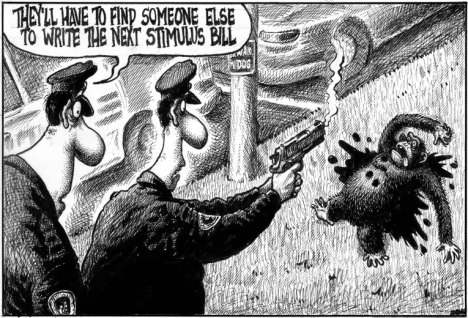
The highest-ranking black congressman questioned Thursday whether South Carolina’s governor was “playing the race card” when he compared using federal stimulus money to Zimbabwe and other nations that printed cash in tough economic times.
Gov. Mark Sanford wrote a letter to President Barack Obama on Thursday asking for a waiver to spend $700 million in stimulus money to pay down some of the state’s debt — a day after comparing the package to other countries that dealt with hard times ineptly. Sanford has been an outspoken critic of the stimulus but hasn’t outright refused any of the money.
Rep. Jim Clyburn, D-S.C., has already lambasted Sanford and other governors who said they may not take some of the stimulus money, calling such a move a “slap in the face of African-Americans” last month. Thursday brought renewed sparring, as Clyburn criticized Sanford for mentioning Zimbabwe.
The comparison “was beyond the pale,” Clyburn said. “The question that ought to be asked of him: Is he playing the race card? I don’t know why he picked that country.”
With the federal economic stimulus bill out of Congress and signed by the President, CSI has prepared a second set of talking points intended to ensure that stimulus funds are distributed equitably, and address the needs of communities of color.
Communities of color are especially vulnerable in challenging economic times and it is critical that we implement the stimulus in a way that recognizes this. These talking points examine the role that race played in creating the financial crisis, and the need to address subprime and predatory lending and the lack of affordable housing for communities of color. This will not only address the needs of these communities, but hasten recovery: research has shown that lifting up the poorest among us actually benefits us all.
We hope that these talking points will be used by advocates working at the state level to ensure that implementation of the stimulus bill.
January 30, 2009. Center for Social Inclusion Issues Talking Points, Calls for Advocacy to Ensure that Economic Stimulus Does not Leave People of Color in the Cold.
The Center for Social Inclusion (CSI) has released a set of talking points intended to help racial justice advocate affect the implementation of economic stimulus, and to make sure that it is a fair and effective process.
“The stimulus package bypasses economic stimulus in communities of color, and in the current environment, that will harm us all,” says CSI Director Maya Wiley. “But we can change that if we focus on advocacy at the state level. States will be responsible for distributing the funds, and we can make sure that they do so in a racially inclusive and equitable way.”
The StopDog team is taking a hiatus, but we hope to be back for the policy debates that the presidential transition will bring. In the meantime, we do want your feedback on what StopDog should do next!
How can we support more education around symbolic racism, and organizing and advocacy..ya know, help community organizers govern?
If you get a chance to see The Boogie Man: The Lee Atwater Story, you will watch the architect of the modern-day GOP’s political strategy to win elections, which is to smear the other person with slimy personal attacks and vicious lies to keep Americans focused on the politics of personal destruction while feigning innocence. The idea is that those smear tactics will deflect us away from the real issues that Americans face every day. Karl Rove, Atwater’s best student, has taken over since he died and has succeeded in continuing that disgusting legacy. Up until now, that is.
Politics has been a dirty game throughout our history, but even Michael Dukakis had no ideahow to respond to the Willie Horton ad, and in the movie he says as much. He thought it was beneath him to respond to such shameful accusations and he realized that he was wrong a little too late. Part of Atwater’s strategy was also to get theses smears planted into the main stream press and he succeeded on that level as well. “Bernard Shaw dealt a crushing blow to the Dukakis candidacy by asking the Massachusetts governor about Horton with the opening question of his final debate with George H. W. Bush.”
…
And as the debates finished, Obama retook the lead in all the polls, because Americans saw that in response to a crisis, he truly looked like a Commander-in-Chief. Even the Conservative Talking Head Brigade of Charles Krauthammer and Dick Morris agreed with this assessment.
And how has all these wild and desperate smears worked far as we all vote on election day? Instead of the politics of personal destruction tearing down Obama, his lead widened and poll after poll told us that McCain was just being downright nasty. Instead realizing the ineffectiveness and addressing the issues at hand, the McCain camp continued a campaign of personal attacks.
So today is the day we all get to find out if the Lee Atwater school of politics has been defeated by the reality of our economic situation.
It has taken a real crisis to combat the very successful campaign strategy that Atwater championed to win George H.W. Bush the White House in ’88. The same techniques that Karl Rove mastered and implemented in beating McCain and then Gore in 2000 and Kerry in 2004. Will truth and reality finally win out?
I wish I could tell you that Americans henceforth will never be influenced by scurrilous personal attack ads and campaign smears in the future, but my hope today is that finally this great nation has been shocked into actually using their brains to decide who should lead us out of the wilderness that came upon due to the negligence of Conservatism. I think Americans unfortunately have a short memory span and these dirty tactics will always be with us. If Obama wins, then I do think that America have no excuses any more if they do get taken in by these cowardly tricks. So I say to you now:
Barak Obama was born into an American that was a deeply segregated place. The son of a black father and a white mother, his parents could not even have lived in the same house in 1961 in about 18 different states. Anyone predicting that the son of this union would one day be president would have risked being committed in a mental hospital. The idea of a black president was not just remote, it was impossible to conceive. Only in a science fiction story about an alternative universe could the parents of the baby Barak Obama have thought he would one day be president of the Harvard Law Review, a member of the U.S. Senate, and eventually the primary resident of the White House. Welcome to the alternative universe of 2008.
An Obama presidency will not end racism. It may in fact lead to some increase in overt racist talk, as those who don’t like his policies will blame them on race. But in other ways, an Obama presidency will change the nature of race relations. Whites who said they would never vote for a black man, in the end did just that. The Republican Party, which played the race card so effectively with Willie Horton in 1988, was unable to do so this time. Fringe Republicans and supporters of McCain offered up offensive and nasty racist characterizations of Obama, including distributing handbills that looked like food stamps with Obama on them. The McCain campaign did not denounce these, but neither did it embrace such actions. In a last desperate effort the McCain campaign focused on Obama’s former preacher, Rev. Wright. But a radical minister is no Willie Horton, and no one seemed to be much affected by the effort.
Even as he became the first black president, Obama transcended race. His earliest support did not come from the black community, but from upper middle class Americans of all races, who were charmed by his intelligence and thoughtfulness and anxious to find a new political leader in the new century. Obama campaigned on economics, foreign policy, health care, and jobs. He rarely spoke of inequality or civil rights, not because he is not concerned about them, but because he understood that they were not the central issues of the election. Furthermore, he understood and inequality in health care and jobs opportunity cannot be overcome until we all have health care and the economy is no longer in free fall. Thus, Obama campaigned on issues that affect all Americans, without regard to race, geography, or class.
Indeed, in the end Obama is not America`s first black president — he is America`s first president who happens to be black. The difference is huge.
OH great, I thought we would get a “grace period” here we go with the “Michelle Obama cuts her husband down to size” meme courtesy of the Telegraph. While they did let us know one interesting tidbit, Michelle Obama will be the youngest First Lady Since Jackie O, they had to get in several dings:
Others may gush over her husband but Michelle Obama, not only the first black First Lady but one of the youngest presidential wives since Jackie Kennedy, likes to be brutally honest about him. Critics have labelled her arrogant, haughty, cold and an “angry black woman”. Supporters portray her instead as independent-minded, unafraid to speak out and a devoted mother who puts family firmly before career.
During the campaign she would give a standard 45 minute stump speech, which she wrote herself and delivered without notes. While other would-be presidential wives traditionally stick to sunny, uncontroversial topics, Mrs Obama would tackle issues such as education and inequality.
And, of course, she talked about her husband. Thanks to her, we now know that the president elect never puts the butter away, cannot make beds and tends to be a bit smelly in the mornings. Such tidbits might have helped humanise the Obama image but critics claimed she emasculated him.
StopDogWhistleRacism.com's purpose is to inform and inspire intelligent discussion and debate from individuals from a full spectrum of experiences, ideologies, parties and perspectives.
In order to reduce spam, the first time you leave a comment you will have to sign up for a username. After that you will be able to join the discussion just using your username and password.
Also, please note that all comments should be expressed in a mature and civil tone of voice. Strong debate is fine, vulgarity and personal attacks are not. Individuals posting rude or otherwise inappropriate material will have their comment privileges rescinded.




 Stop Dog Whistle Racism!
